Marketing Strategy vs. Marketing Tactics: Why the Difference Matters
Many business owners use the terms marketing strategy and marketing tactics interchangeably.
They’re closely related—but they’re not the same thing.
Understanding the difference can mean the difference between marketing that feels random and marketing that consistently drives growth.
If you’ve ever said, “We’ve tried marketing, but it didn’t work,” there’s a good chance the issue wasn’t the tactics—it was the strategy behind them.
Let’s break it down.
What Is a Marketing Strategy?
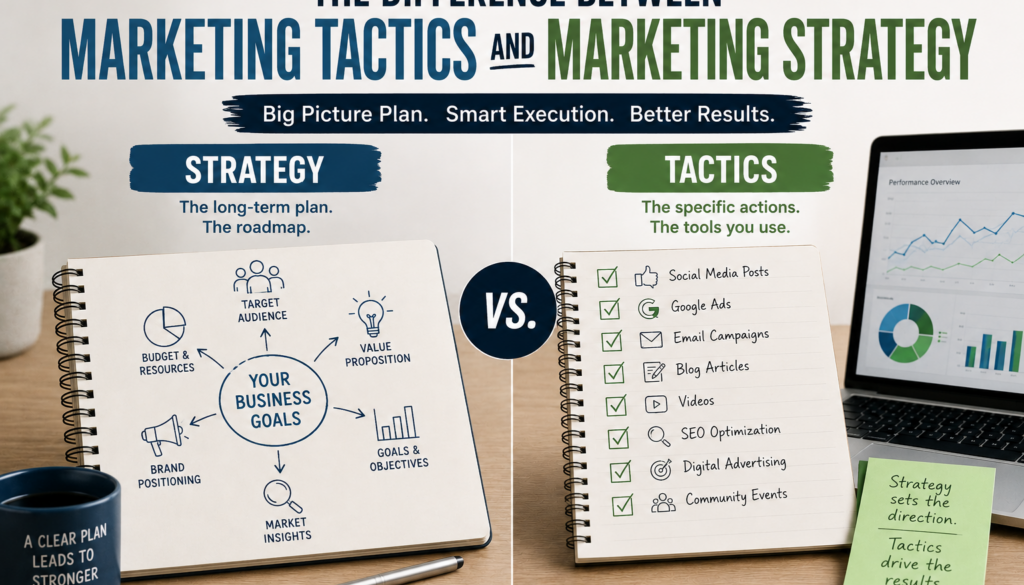
A marketing strategy is your long-term plan.
It answers the big-picture questions, such as:
- Who is our ideal customer?
- What problems do we solve?
- What makes us different?
- What are our business goals?
- Where should we invest our marketing budget?
- How will we measure success?
Your strategy serves as the roadmap that guides every marketing decision you make.
Without one, it’s easy to chase trends, spend money in the wrong places, or create marketing that doesn’t support your business goals.
What Are Marketing Tactics?
Marketing tactics are the individual actions you take to execute your strategy.
Examples include:
- Posting on social media
- Running Google Ads
- Email marketing campaigns
- Writing blog articles
- Search engine optimization (SEO)
- Creating videos
- Sending direct mail
- Hosting community events
- Digital display advertising
- Pay-per-click advertising
These are the tools you use—but they only work well when they’re supporting a larger plan.
Think of It Like Building a House
Imagine you’re building a house.
Your strategy is the blueprint.
It determines:
- The size
- The layout
- The materials
- The overall vision
Your tactics are the individual tasks:
- Pouring the foundation
- Framing the walls
- Installing the roof
- Painting the rooms
No matter how well you paint a room, it won’t help if the blueprint was flawed.
The same is true in marketing.
What Happens Without a Strategy?
This is one of the most common situations we see.
A business owner says:
- “We need to post more on Facebook.”
- “Let’s boost this post.”
- “Someone told me we need TikTok.”
- “Maybe we should buy Google Ads.”
Those ideas aren’t necessarily bad.
But they’re being made without asking whether they support the business’s overall goals.
Marketing becomes reactive instead of intentional.
The result is often:
- Inconsistent branding
- Wasted advertising dollars
- Mixed messaging
- Low return on investment
- Frustration because “nothing seems to work”
A Strategy Makes Every Dollar Work Harder
A strong strategy helps you decide:
- Which platforms deserve your attention
- What content to create
- Which audiences to target
- Where your advertising budget should go
- What success looks like
Instead of trying everything, you’re investing in the tactics most likely to produce results.
Every Business Needs a Different Strategy
One of the biggest misconceptions in marketing is that if something works for one business, it will work for another.
The truth is that every business is different.
A local restaurant has different goals than an accounting firm.
A nonprofit communicates differently than an online retailer.
A startup has different priorities than a business that’s been established for 30 years.
That’s why successful marketing isn’t about copying competitors—it’s about building a strategy around your own business, customers, and goals.
Strategy Is Ongoing
A marketing strategy isn’t something you create once and forget.
Markets change.
Customer behavior evolves.
Technology advances.
Your business grows.
The best marketing strategies are reviewed regularly and adjusted as new opportunities emerge.
That flexibility allows your marketing to stay relevant without losing sight of your long-term objectives.
Tactics Without Strategy Create Noise
Posting every day doesn’t guarantee results.
Running ads doesn’t automatically generate sales.
Publishing blogs doesn’t matter if they aren’t reaching the right audience.
The tactics themselves aren’t the problem.
The problem is using tactics without a strategy to guide them.
When your strategy is clear, every piece of marketing has a purpose—and every tactic supports a larger business goal.
Build a Strategy Before You Build Campaigns
Marketing shouldn’t feel like guessing.
When you begin with a clear strategy, choosing the right tactics becomes much easier, and your marketing starts working together instead of competing for attention.
At Stinson Communications, we believe effective marketing starts with understanding your business—not applying a one-size-fits-all solution. We develop customized marketing strategies designed around your goals, then execute the tactics that help turn those plans into measurable results.
A strong strategy doesn’t replace great marketing tactics—it makes them far more effective.