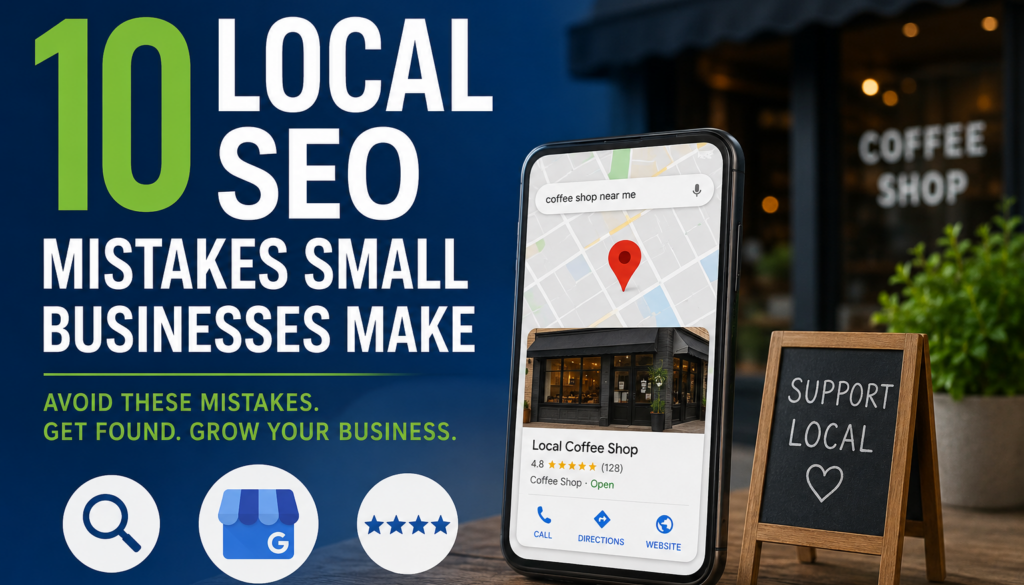
10 Local SEO Mistakes Small Businesses Make (And How to Avoid Them)
When customers need a product or service, they rarely reach for a phone book anymore. Instead, they search Google for businesses “near me” or in their city. If your business isn’t showing up in those searches, you’re likely losing customers to competitors who are.
The good news? Many local SEO problems are surprisingly easy to fix.
Here are 10 of the most common local SEO mistakes small businesses make—and what you can do instead.
1. Ignoring Your Google Business Profile
Your Google Business Profile is one of the most important tools for local visibility. Yet many businesses claim it and then never update it.
Make sure your profile includes:
- Current business hours
- Accurate phone number
- Website link
- Business description
- Services
- High-quality photos
An active, complete profile helps Google trust your business and gives customers confidence before they ever visit your website.
2. Using Inconsistent Contact Information
Your business name, address, and phone number (often called NAP) should be exactly the same everywhere online.
Even small differences like:
- “Street” vs. “St.”
- Different phone numbers
- Old addresses
can confuse search engines and weaken your local rankings.
Consistency matters.
3. Forgetting About Reviews
Reviews aren’t just about reputation—they’re also an important local SEO ranking factor.
Businesses that consistently earn positive reviews tend to receive more visibility in local search results.
Encourage happy customers to leave reviews, and always respond professionally—both to positive and negative feedback.
4. Targeting Keywords That Are Too Broad
Trying to rank for “plumber” or “marketing agency” alone is extremely competitive.
Instead, focus on phrases people in your community actually search, such as:
- Emergency plumber in Roanoke
- Family dentist in Lynchburg
- Digital marketing agency in Southwest Virginia
Local keywords help attract customers who are ready to buy.
5. Not Creating Location-Specific Content
Many businesses only have a homepage and service pages.
Instead, create helpful content that speaks directly to your local audience.
Examples include:
- Community events
- Local customer success stories
- Area-specific service pages
- Frequently asked questions from local clients
- Educational blog articles
Google rewards businesses that demonstrate local relevance.
6. Having a Slow Website
Customers won’t wait for a slow website—and neither will Google.
A website that loads slowly can increase bounce rates and lower search rankings.
Improve performance by:
- Compressing images
- Removing unnecessary plugins
- Using quality website hosting
- Optimizing for mobile devices
Fast websites create better customer experiences.
7. Ignoring Mobile Users
Most local searches happen on smartphones.
If customers have to zoom, scroll sideways, or struggle to find your phone number, they’ll likely move on to a competitor.
Your website should:
- Load quickly
- Display properly on all screen sizes
- Have clickable phone numbers
- Make directions easy to find
8. Missing Local SEO on Website Pages
Many businesses optimize their homepage but forget every other page.
Each page should include:
- Unique title tags
- Meta descriptions
- Relevant keywords
- City or service area when appropriate
- Helpful, original content
Every page is an opportunity to appear in search results.
9. Never Updating Your Website
A website that hasn’t changed in years sends the wrong message to both Google and potential customers.
Regular updates show that your business is active.
Consider adding:
- Monthly blog posts
- New photos
- Recent projects
- Team updates
- New services
- Customer testimonials
Fresh content gives search engines more reasons to crawl your website.
10. Expecting SEO to Work Overnight
One of the biggest mistakes is assuming SEO is a quick fix.
Unlike paid advertising, SEO builds momentum over time. Businesses that consistently improve their website, publish helpful content, collect reviews, and maintain accurate information typically see stronger long-term results.
The businesses that invest consistently are often the ones that dominate local search results.
Local SEO Is About Building Trust
Local SEO isn’t about tricking search engines—it’s about making it easy for customers to find, trust, and choose your business.
When your website is optimized, your Google Business Profile is active, and your online information is consistent, you’re creating a stronger digital presence that works for your business around the clock.
Small improvements made consistently can lead to more website traffic, more phone calls, and more qualified leads over time.
Ready to Improve Your Local Search Rankings?
If your business isn’t appearing where your customers are searching, it may be time for a local SEO strategy that goes beyond the basics.
At Stinson Communications, we help businesses improve their online visibility through local SEO, website optimization, content marketing, Google Business Profile management, and digital marketing strategies designed to generate real results.
Let’s help your customers find you first.