Marketing Metrics Every Business Owner Should Understand
If you’ve ever looked at a marketing report and thought, “I have no idea what any of this means,” you’re not alone.
Marketing platforms can provide hundreds of data points, charts, and reports. While that information can be valuable, it can also feel overwhelming.
The good news?
You don’t need to understand every metric to make informed business decisions.
Instead, focus on the numbers that actually help you evaluate whether your marketing is working.
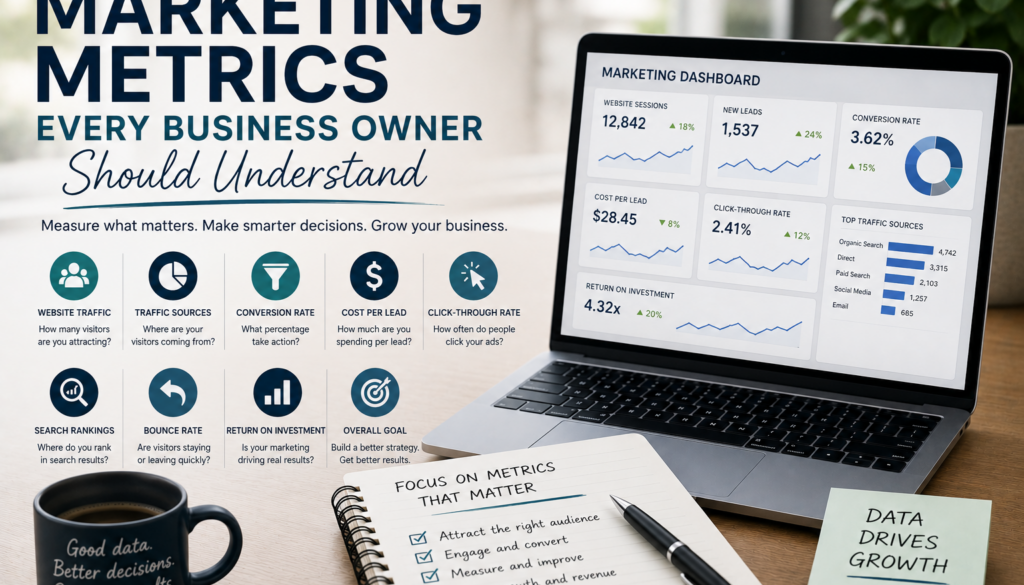
Here are some of the most important marketing metrics every business owner should know.
1. Website Traffic
Website traffic tells you how many people are visiting your website.
While it’s helpful to know how many visitors you’re attracting, traffic alone doesn’t tell the whole story.
Ask yourself:
- Are visitors finding the pages you want them to see?
- Are they staying on your website?
- Are they taking action?
Traffic is only valuable if it leads to meaningful engagement.
2. Traffic Sources
Knowing where your visitors come from helps you understand what’s working.
Common traffic sources include:
- Organic search (SEO)
- Google Ads
- Social media
- Email marketing
- Direct visits
- Referral websites
Understanding these sources helps you invest more confidently in the marketing channels producing results.
3. Conversion Rate
One of the most important metrics is your conversion rate.
This measures the percentage of visitors who complete a desired action, such as:
- Filling out a contact form
- Calling your business
- Booking an appointment
- Making a purchase
- Signing up for your newsletter
A website with fewer visitors but a higher conversion rate often outperforms one with lots of traffic but very few leads.
4. Cost Per Lead (CPL)
If you’re investing in advertising, Cost Per Lead is a key number.
It tells you how much you’re spending to generate one qualified lead.
Lower isn’t always better.
The goal is attracting quality leads—not simply the cheapest ones.
5. Click-Through Rate (CTR)
CTR measures how often people click your advertisement, email, or search result after seeing it.
A strong click-through rate often indicates your message is relevant to your audience.
If it’s low, it may be time to improve your headlines, images, or calls to action.
6. Search Rankings
Where your website appears in Google search results can have a significant impact on visibility.
Monitoring keyword rankings helps you understand whether your SEO efforts are improving over time.
Remember, SEO is a long-term investment.
Progress happens gradually.
7. Bounce Rate
Bounce rate measures how many visitors leave your website after viewing only one page.
A high bounce rate can sometimes indicate:
- Slow loading pages
- Confusing navigation
- Weak messaging
- Irrelevant content
- Poor user experience
The goal isn’t simply getting visitors to your website.
It’s encouraging them to stay and explore.
8. Return on Investment (ROI)
At the end of the day, this is the number most business owners care about.
ROI measures whether your marketing investment is producing meaningful business results.
It’s not just about impressions or clicks.
It’s about whether your marketing is helping your business grow.
Don’t Chase Vanity Metrics
It’s easy to become excited about:
- Thousands of impressions
- Hundreds of likes
- Large follower counts
While those numbers may look impressive, they don’t always translate into new business.
Instead, focus on metrics that support your goals.
Ask yourself:
- Are we generating more qualified leads?
- Are more people contacting our business?
- Are we attracting the right customers?
- Is our marketing contributing to revenue?
Those are the numbers that matter most.
Use Data to Make Better Decisions
Marketing data shouldn’t be intimidating.
It should help you make smarter decisions.
When you understand what’s working, you can:
- Invest more confidently.
- Improve underperforming campaigns.
- Identify new opportunities.
- Eliminate wasted spending.
- Build a stronger long-term strategy.
The goal isn’t collecting more data.
It’s using the right data.
The Bottom Line
You don’t need to become a marketing analyst to understand whether your marketing is working.
By focusing on a handful of meaningful metrics—such as website traffic, conversion rates, cost per lead, search rankings, and ROI—you’ll be better equipped to make informed decisions that support your business goals.
At Stinson Communications, we believe marketing reports should provide clarity—not confusion. We help our clients understand the numbers that matter most, translating complex analytics into actionable insights that improve performance and support long-term growth.
Because good marketing isn’t about collecting more data.
It’s about using data to make better decisions.