What Makes a Website Convert Visitors into Customers?
Getting people to visit your website is only half the battle.
The real question is: What happens once they get there?
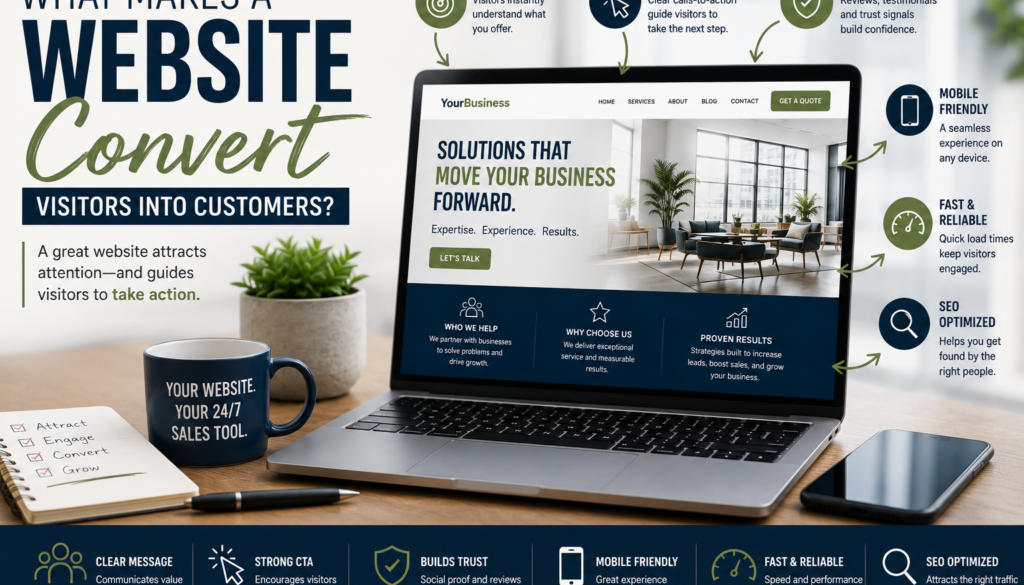
A successful website doesn’t just attract visitors—it guides them toward taking action. Whether that’s making a purchase, requesting a quote, scheduling a consultation, or picking up the phone, every page should have a purpose.
If your website gets traffic but isn’t generating leads, it may not be a traffic problem. It may be a conversion problem.
Here are the key elements that turn website visitors into customers.
1. A Clear First Impression
Visitors decide within seconds whether they’re in the right place.
Your homepage should immediately answer three questions:
- What do you do?
- Who do you help?
- Why should someone choose you?
If visitors have to hunt for that information, many will leave before exploring the rest of your website.
Simple, clear messaging almost always outperforms clever wording.
2. Strong Calls-to-Action
Once someone understands what you offer, they need to know what to do next.
Every page should include a clear call-to-action (CTA), such as:
- Request a Quote
- Schedule a Consultation
- Contact Us
- Shop Now
- Call Today
Don’t assume visitors will know the next step. Guide them through the journey.
3. Trust Signals
People buy from businesses they trust.
Your website should provide reassurance through:
- Customer reviews
- Testimonials
- Awards and certifications
- Industry affiliations
- Case studies
- Years of experience
- Photos of your team
- Secure website (HTTPS)
These elements help reduce uncertainty and build confidence before a customer ever contacts you.
4. Easy Navigation
Confusing navigation frustrates visitors.
Your website should make it simple to find:
- Services
- Products
- Pricing (when appropriate)
- Contact information
- FAQs
- About Us
- Customer reviews
If people can’t find what they’re looking for quickly, they’ll likely leave and visit a competitor.
5. Mobile-Friendly Design
Today’s customers are searching from phones, tablets, laptops, and desktops.
A website that looks great on a computer but is difficult to use on a smartphone creates a poor experience.
A mobile-friendly website should include:
- Fast loading pages
- Readable text
- Clickable phone numbers
- Simple navigation
- Easy-to-complete contact forms
A positive mobile experience can make the difference between earning a customer or losing one.
6. Fast Load Times
Website speed matters.
Studies consistently show that people abandon websites that take too long to load.
Slow pages can also affect your search engine rankings.
Improve performance by:
- Compressing images
- Removing unnecessary plugins
- Using quality web hosting
- Optimizing your code
- Regularly maintaining your website
Fast websites keep visitors engaged.
7. Helpful Content
Customers often have questions before they’re ready to buy.
Helpful content answers those questions and positions your business as a trusted resource.
Consider including:
- Blog articles
- Frequently Asked Questions
- Buying guides
- Service explanations
- Educational videos
- Customer success stories
When your website helps people make informed decisions, they’re more likely to choose your business.
8. Consistent Branding
Every page should feel like it belongs to the same company.
Consistent branding includes:
- Colors
- Fonts
- Photography style
- Messaging
- Tone of voice
- Logo usage
Consistency creates familiarity, and familiarity builds trust.
9. SEO That Brings the Right Visitors
A website can’t convert visitors who never find it.
Search engine optimization helps attract people who are actively looking for your products or services.
Good SEO focuses on:
- Relevant keywords
- Helpful content
- Fast performance
- Local optimization
- Well-structured pages
The goal isn’t simply more traffic—it’s attracting the right traffic.
10. A Customer-Focused Experience
Perhaps the biggest difference between high-converting websites and average ones is perspective.
Many websites focus almost entirely on the business.
Instead, successful websites focus on the customer.
Rather than asking:
“What do we want to say?”
Ask:
“What does our customer need to know to feel confident choosing us?”
That simple shift changes everything.
Great Websites Don’t Happen by Accident
Every headline, button, image, and page should work together to guide visitors toward becoming customers.
A website isn’t just an online brochure—it’s one of the most valuable sales and marketing tools your business has.
When it’s thoughtfully designed, optimized, and focused on the customer experience, it continues working long after your office closes for the day.
Turn More Visitors into Customers
If your website is attracting traffic but not generating the leads or sales you expected, it may be time to rethink how it’s guiding visitors through the customer journey.
At Stinson Communications, we design websites that do more than look good. We create websites built around strategy, user experience, search engine optimization, and conversion-focused design to help businesses attract, engage, and convert the right audience.
Because a successful website isn’t measured by how many people visit—it’s measured by how many people become customers.