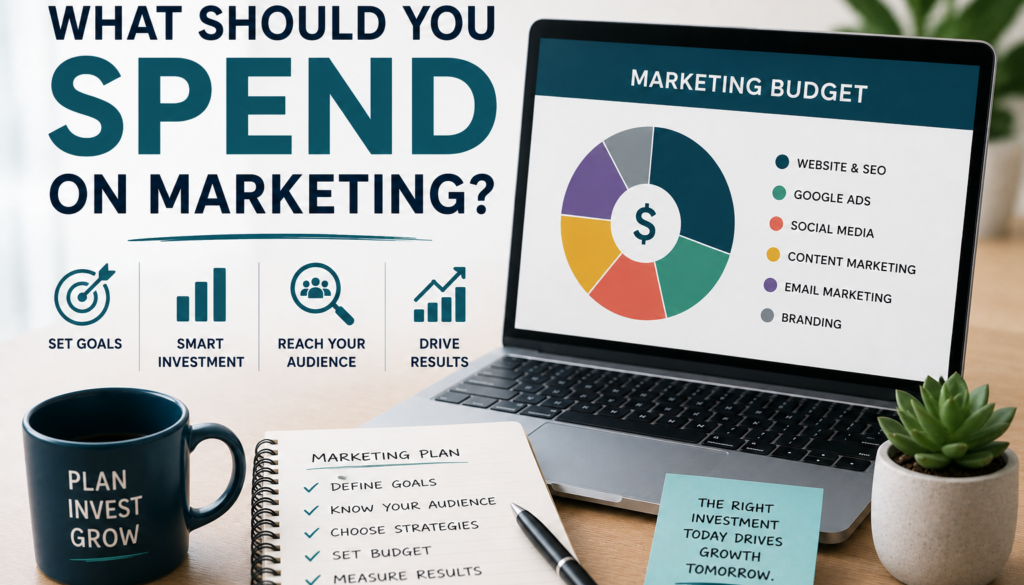
What Should You Spend on Marketing?
One of the first questions business owners ask is:
“How much should I spend on marketing?”
It’s a fair question—but it’s also one of the hardest to answer.
The truth is, there isn’t a universal number that works for every business.
Your marketing budget depends on your goals, your industry, your competition, and where your business is today.
The better question is:
“What should my marketing investment accomplish?”
When you shift your thinking from cost to results, budgeting becomes much easier.
Marketing Is an Investment, Not Just an Expense
It’s easy to look at marketing as another monthly bill.
But unlike utilities or office supplies, effective marketing has the potential to generate revenue.
A well-planned marketing strategy can help you:
- Increase brand awareness
- Generate qualified leads
- Build customer trust
- Improve customer retention
- Increase sales
- Support long-term business growth
The goal isn’t simply to spend money.
The goal is to create a return on your investment.
There’s No One-Size-Fits-All Budget
A local startup has different marketing needs than an established company serving multiple states.
Likewise, a retail store will likely invest differently than a law firm, contractor, nonprofit, or healthcare practice.
Factors that influence your marketing budget include:
- Your industry
- Revenue goals
- Market competition
- Geographic reach
- Current brand awareness
- Growth objectives
- Available resources
That’s why cookie-cutter marketing packages rarely produce the best results.
Start With Your Business Goals
Before deciding on a budget, ask yourself:
- Are you trying to increase sales?
- Generate more leads?
- Launch a new product or service?
- Expand into a new market?
- Improve brand awareness?
- Build long-term visibility through SEO?
Your marketing strategy—and your investment—should support those goals.
Focus on the Right Marketing Channels
Not every business needs to invest in every platform.
Depending on your audience, your marketing plan may include:
- Website improvements
- Search Engine Optimization (SEO)
- Google Ads
- Social media marketing
- Content creation
- Email marketing
- Video marketing
- Local advertising
- Brand development
The best strategy isn’t about doing everything.
It’s about investing in the channels that produce the greatest impact for your business.
Don’t Expect Overnight Results
Some marketing efforts generate results quickly.
Paid advertising, for example, can begin driving traffic soon after campaigns launch.
Other strategies—such as SEO, blogging, and brand building—take time but continue providing value long after the initial investment.
The strongest marketing plans balance short-term wins with long-term growth.
Measure What Matters
A marketing budget should never be based on guesswork.
Instead, track meaningful metrics such as:
- Website traffic
- Qualified leads
- Phone calls
- Contact form submissions
- Sales
- Search rankings
- Cost per lead
- Return on investment (ROI)
Data helps you understand what’s working, what’s not, and where to invest moving forward.
The Cost of Doing Nothing
Many business owners worry about spending money on marketing.
But there’s another cost that’s often overlooked:
The cost of being invisible.
If potential customers can’t find your business online…
If your competitors are consistently showing up in search results…
If your website isn’t generating leads…
You’re already paying a price.
Sometimes the biggest risk isn’t investing in marketing.
It’s not investing at all.
Think Long-Term
Marketing isn’t a one-time event.
It’s an ongoing process of building awareness, earning trust, attracting customers, and strengthening your brand.
Businesses that market consistently often see better long-term results than those that only advertise when sales slow down.
Consistency creates momentum.
Momentum creates growth.
The Bottom Line
There isn’t a perfect marketing budget that fits every business.
The right investment is the one that aligns with your goals, reaches your ideal audience, and delivers measurable results over time.
At Stinson Communications, we don’t believe in one-size-fits-all marketing packages. We work with businesses to develop customized marketing strategies based on their goals, budget, and growth opportunities. Whether you’re investing in SEO, websites, Google Ads, social media, or content marketing, our focus is helping you make smart marketing decisions that support sustainable growth.
Because successful marketing isn’t about spending more.
It’s about investing wisely.