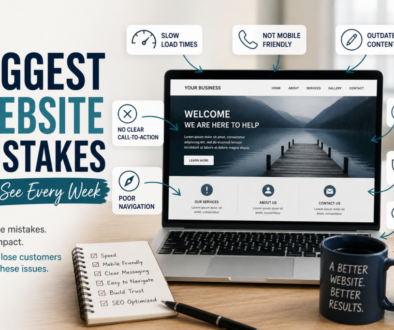
The 10 Biggest Website Mistakes We See (And How to Avoid Them)
our website is often the first impression potential customers have of your business.
Within seconds, visitors decide whether they’ll stay, explore, or leave—and that decision can have a direct impact on your bottom line.
Over the years, we’ve reviewed websites across a wide range of industries, and while every business is unique, we tend to see the same problems over and over again.
The good news?
Most of these mistakes are completely fixable.
Here are ten of the biggest website mistakes we see—and how you can avoid them.
1. Unclear Messaging
When someone lands on your homepage, they should immediately understand:
- What you do
- Who you help
- Why they should choose you
If visitors have to hunt for that information, they’ll likely leave before becoming customers.
Fix it: Make your value proposition clear within the first few seconds.
2. Slow Load Times
Patience is short online.
If your website takes too long to load, visitors often leave before they ever see your content.
Slow websites can also hurt your search engine rankings.
Fix it: Optimize images, reduce unnecessary plugins, and regularly monitor your site’s performance.
3. No Clear Call to Action
Many websites explain what a business does but never tell visitors what to do next.
Don’t assume people know how to contact you.
Guide them.
Examples include:
- Schedule a Consultation
- Request a Quote
- Book an Appointment
- Contact Our Team
Every page should encourage the next step.
4. Poor Mobile Experience
More than half of all website traffic now comes from mobile devices.
If your website is difficult to navigate on a phone, you’re likely losing potential customers.
Fix it: Test your website on multiple screen sizes and prioritize a responsive design.
5. Outdated Content
Nothing damages credibility faster than a website announcing an event from two years ago or showcasing discontinued services.
Visitors notice.
Fix it: Review your website regularly and keep your content current.
6. Weak or Missing SEO
A beautiful website won’t help if no one can find it.
Many websites are missing optimized page titles, meta descriptions, keywords, image alt text, and internal links.
Fix it: Build your website with search engines—and your audience—in mind.
7. Too Much Clutter
Trying to say everything at once often results in saying nothing clearly.
Crowded layouts, excessive text, and competing calls to action overwhelm visitors.
Fix it: Simplify your design. Give your content room to breathe and focus on what matters most.
8. Missing Trust Signals
People want reassurance before they contact a business.
If your website lacks reviews, testimonials, certifications, case studies, or examples of your work, visitors may hesitate.
Fix it: Showcase social proof throughout your website.
Trust is earned before someone fills out your contact form.
9. Ignoring Analytics
You can’t improve what you don’t measure.
Many business owners have no idea:
- Which pages people visit
- Where visitors come from
- How long they stay
- Which pages generate leads
Without data, you’re making marketing decisions based on guesswork.
Fix it: Use tools like Google Analytics and Google Search Console to understand how your website is performing.
10. Treating Your Website Like a One-Time Project
One of the biggest misconceptions is that websites are “finished.”
They’re not.
Your business changes.
Your customers change.
Search engines change.
Your website should evolve too.
Regular updates, fresh content, improved SEO, and ongoing optimization help keep your website working for your business—not against it.
Your Website Should Be Your Best Salesperson
Unlike your office, your website never closes.
It works nights, weekends, and holidays.
It should be answering questions, building trust, showcasing your expertise, and encouraging visitors to take action—24 hours a day.
If it isn’t doing those things, it’s time to make some improvements.
The Bottom Line
Your website doesn’t have to be perfect.
It just needs to communicate clearly, provide a great user experience, and guide visitors toward becoming customers.
At Stinson Communications, we believe successful websites combine thoughtful design, strategic messaging, search engine optimization, and ongoing improvements to create results that last. Whether you’re building a new website or improving an existing one, our goal is simple: create a website that works as hard as you do.
Because the best websites don’t just attract visitors.
They turn visitors into customers.